Get garage door opener repair in Cleveland for remote, keypad, sensor or motor trouble. CLE checks the opener and door, explains repair or replacement options and confirms the price before you approve any work.
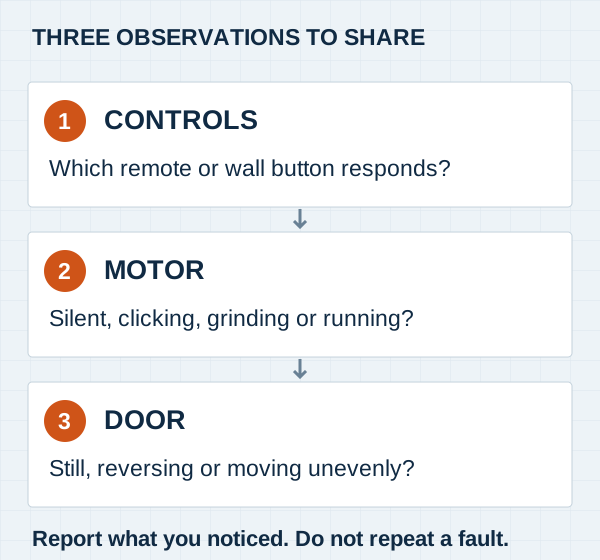
Describe the sequence, without diagnosing it.Use what you already noticed. Do not run a damaged door again, bypass sensors or disconnect a raised door.
REQUEST OPENER REPAIR
Get help with the opener you have.
We’ll confirm coverage and availability, inspect the concern and explain the options. Sending a request does not book an appointment or take payment.
Choose the closest description. These are safe observations to share with us, not a remote diagnosis.
Nothing responds
Start with power and the controls.
If the door is fully closed and looks undamaged, note whether the opener light and wall control have power. Does the wall button work when the remote does not?
Tell us which controls you tried and whether the light comes on. Power, a control fault and a failed opener can look similar from the driveway.
Nothing responds: Start with power and the controls.
If the door is fully closed and looks undamaged, note whether the opener light and wall control have power. Does the wall button work when the remote does not? Tell us which controls you tried and whether the light comes on. Power, a control fault and a failed opener can look similar from the driveway.
When to stop: A loud bang, a visible spring gap or a crooked door changes the situation. Leave the door in place and request a door-system inspection.
Remote or keypad fails: One failed control does not mean a failed opener.
If only one remote has stopped working, check its battery using its instructions. Note whether another remote or the wall control still works. A keypad may have a different battery and programming procedure. Share the opener brand and model, and the accessory model if you know it. We check compatibility before recommending a replacement control.
When to stop: Do not climb to find a label or reset unfamiliar controls. A photo of information you can see safely is enough.
Door closes, then reverses: Report the pattern; keep the safety system working.
From a safe position, look for objects in the doorway or in front of the low-mounted sensors. Note the sensor lights and any flashing opener light. Use the instructions for your exact model. Tell us whether the door reverses immediately or near the floor. Sensor trouble, door resistance and opener settings need different repairs.
When to stop: Do not bypass the sensors, hold a control to force a damaged door closed, or increase the opener’s force. Stop if the door is crooked, jerking or visibly damaged.
Motor runs; door stays still: The drive and the door both need checking.
Note whether you hear the motor, a clicking sound or grinding. You do not need to disconnect the opener or try lifting the door to identify the cause. A drive component, connection or door-system problem may be involved. We inspect the door and opener before comparing a repair with replacement.
When to stop: Stop cycling the opener. Do not pull the release on a raised door or try to lift a door that has lost spring support.
The important questions are what failed, what condition the rest of the opener is in, and whether replacement offers something you want.
How we approach the repair-versus-replacement conversation
What we find
What to compare
Remote, keypad or sensor issue
A compatible control or sensor repair may solve the problem without replacing the motor.
Isolated, available repair part
Compare the repair price with the unit’s condition and reliability. A repair can be sensible when the rest of the opener is sound.
Repeated failures or unavailable parts
Compare further repair costs with a complete installed replacement and its warranty.
Door or spring problem
Address the mechanical problem. A stronger or newer motor does not repair a damaged or unbalanced door.
You want quieter operation or new features
Consider a planned upgrade for belt drive, battery backup or phone control, even if the current opener can be repaired.
COMPARE THE WHOLE QUOTE
What will opener repair cost?
A remote battery problem and a worn drive assembly are different jobs. We inspect the concern and explain the recommended work and price before you decide.
For a replacement comparison, our installation page lists complete Chamberlain packages, tax, standard installation and separately priced options. You can compare that scope with the repair quote.
Send the details you already know. You do not need to diagnose the failure.
Why does my garage door only close when I hold the wall button?+
A safety-sensor problem is one possible cause. Do not use that behavior as a workaround or bypass the sensors. Keep the opening clear and arrange an inspection; door resistance and model-specific settings also need checking.
Can you help with a Chamberlain, LiftMaster or Genie opener?+
Tell us the brand, model and symptom. We check the condition, compatibility and availability of suitable parts before confirming a repair. Brand alone does not tell us whether the unit needs replacing.
Does a blinking opener light tell me which part failed?+
Light patterns can help, but they are model-specific. Tell us what flashes and how often, without repeatedly running a damaged door. A code is a starting point for inspection, not proof that a particular part needs replacement.
Do I need a new garage door with a new opener?+
Not automatically. The condition of the door and the condition of the opener are separate decisions. If the door is damaged, compare door repair with door replacement.
What information helps before a visit?+
Your ZIP code, which controls work, what the door does, any unusual sound, and the brand or model if safely visible. Tell us immediately if the door is crooked, a cable is loose or a vehicle is trapped. Photos are optional; stay clear of the door.
Get the fault checked before choosing a replacement.
Send your ZIP code and what the opener does. We’ll confirm availability and discuss the next step.